
DNT Hydra HS650R Review: a month on a 22 Creedmoor coyote rifle
I think this is the best entry-level 640 thermal on the market at it's price point of $2,199.99 (current promotion run by DNT) as a dedicated thermal weapon sight and clip-on. At distances up to 400 yards, I had no issue identifying coyotes in an open field, it handled mist and fog well, and it's laser range finder and onboard ballistics make this a competitive offer.
DNT provided this scope for review. They did not pay for this review, and they asked that I share both the good and the bad.
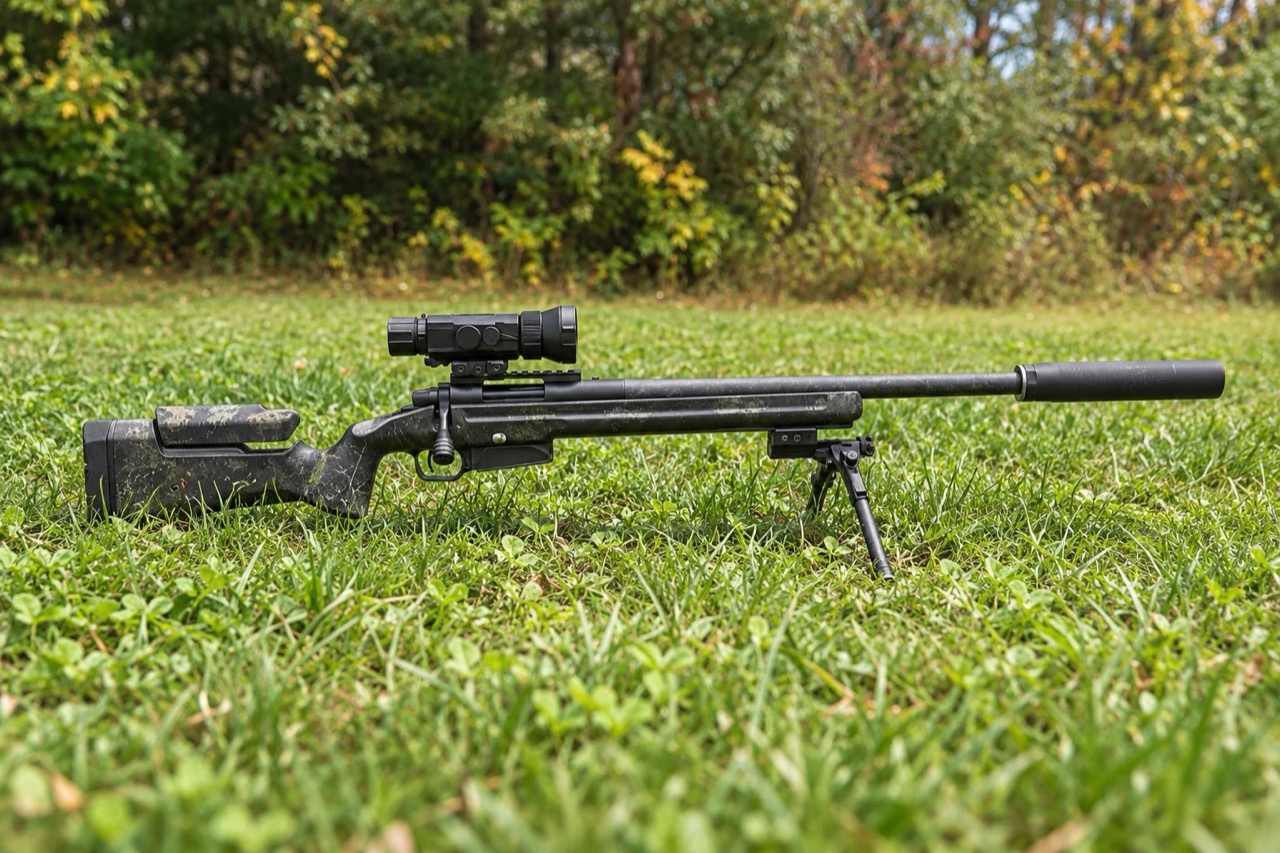
What it is
The DNT HS650R Hydra LRF is the 50 mm model in DNT's Hydra line: a 3-in-1 thermal scope with a laser rangefinder and an onboard ballistic calculator. It can run as a dedicated thermal weapon sight, as a clip-on in front of a day optic, or as a handheld. You can use it handheld, but most people will run it as a clip-on or a dedicated weapon sight.
Price and where it is for sale
At the time of this post, DNT is running a special of $400 off, which makes it only $2,199.99. It is for sale direct from DNT, and it was in stock when I wrote this.
| Sensor | 640×512, 12 µm, 18 mK NETD, 50 fps |
|---|---|
| Objective lens | 50 mm |
| Magnification | 2.5x base; digital steps at 3.5x, 5x, 7.5x and 10x |
| Field of view | 8.8° × 6.6° (15.4 × 11.5 yd at 100 yd) |
| Eye relief | 2.6 in |
| Display | Micro-OLED, 1024×768, 50 Hz |
| Rangefinder | 5 to 1,300 yards; continuous, single pulse or timed |
| Ballistics | 5 ballistic profiles; holdover or dial-in; MRAD, MOA, cm or inches |
| Zeroing | 10 zeroing profiles |
| Reticles | 8 (2 first focal plane, 6 second focal plane), 5 colors |
| Image options | 4 palettes, 3 imaging modes, picture-in-picture |
| Recording | 32 GB built in, 1024×768 at 50 fps, recoil-activated video |
| Battery | One flat-top 18650, up to 4 hours; USB-C external power |
| Weight | 18.2 oz; 25.2 oz with battery and mount |
| Length | 8.4 in |
| Durability | IP67; rated to .50 BMG recoil; -4 to 122°F |
| In the box | QDM150 quick-detach mount, PMS mount, flip-up cover, eye cup |
| Price | About $2,600; $2,199.99 on sale at the time of this post |
How I used it
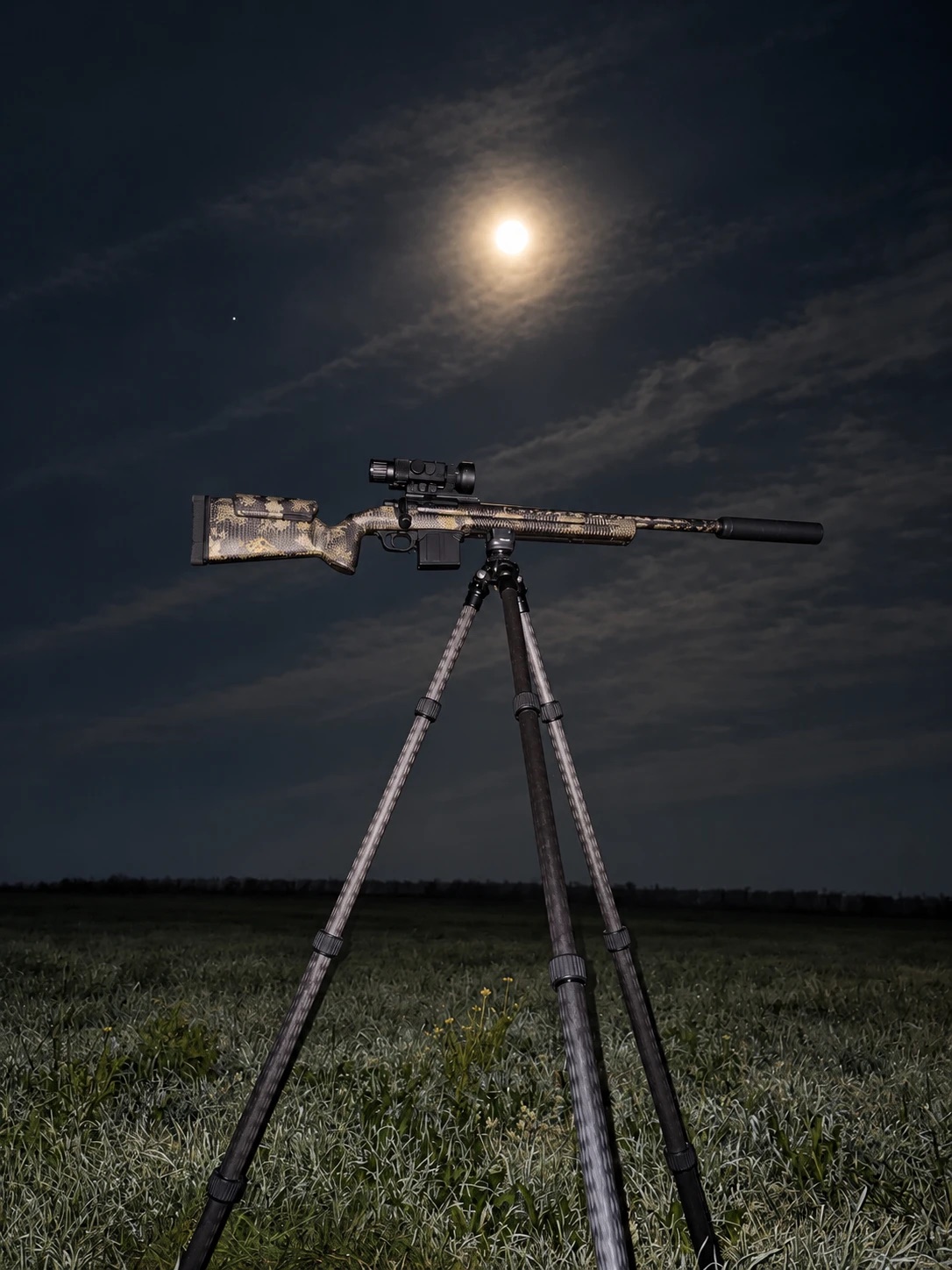
I've had the scope for a little over a month. It lived on a 22 Creedmoor with a 20-inch Proof barrel, a Manners LRH stock and a TriggerTech Diamond trigger, and it was used for coyote hunting in Wisconsin.
I ran it two ways: as a dedicated thermal scope and as a clip-on. I also mounted it to the roof of my truck and used it to scan fields from inside the cab. I spent the majority of my testing as a dedicated thermal weapon sight.
The vehicle setup is two pieces: a magnet mount and a 360-degree remote-controlled pan/tilt.
Image
I can detect coyotes at 400 yards. Fog and humidity are where a lot of thermals go flat, and this one held up great in both.
Some of that comes down to the sensor's sensitivity, which is rated at under 18 mK NETD. NETD stands for noise equivalent temperature difference: the smallest temperature difference the sensor can pick out from its own electronic noise. It is measured in millikelvin (mK), or thousandths of a degree, so 18 mK means the sensor can separate two surfaces that differ by about 0.018°C. Lower is better. It matters most when everything in the scene is close to the same temperature, which is what fog, humidity and rain do to a field.
I'm used to a sensor rated under 15 mK. On paper that one is more sensitive, but the gap is three thousandths of a degree, and both are at the sensitive end of what uncooled thermals offer. Manufacturers don't all measure NETD the same way, so treat small differences between brands as approximate.
The display is a 1024×768 Micro-OLED running at 50 Hz. That is smaller than the 2560 display I'm used to. I don't view that as a negative, but it takes time to get used to and my personal preference is a larger display for the type of hunting I do.
The trade-off is that it keeps the unit small, compact and lightweight. I think its profile is perfect for my 14.5-inch AR-15, which is great for getting in and out of a vehicle.
The scope has four palettes (white hot, black hot, red hot and iron hot) and three imaging modes. Natural is the default. Enhanced raises contrast to bring out a target's outline, at the cost of more noise. Highlight suppresses everything but the strongest heat sources for fast target pickup. Contrast, brightness and sharpness each adjust across five levels.
Above the 2.5x base, zoom is digital, stepping to 3.5x, 5x, 7.5x and 10x. Digital zoom enlarges the picture the sensor already captured and does not add detail, though DNT includes an "Image Super Resolution" setting meant to help at higher zoom. It is part of why I'd like more base magnification, which I cover below.
Zero
Zeroing is easy, and the freeze-frame zero is why.
Freeze frame means the scope takes a still of what it is looking at and holds it on the screen. You aim at the center of the target and fire. Then you put the reticle back on your point of aim and freeze the image. With the picture locked, you move the reticle with the X and Y adjustments until it sits on the bullet hole, then save. The rifle doesn't have to stay perfectly still while you adjust, because you are working on a still image and not a live one.
I zeroed at 100 yards and held a 0.5-inch five-round group with my 22 Creedmoor. DNT recommends 50 yards, but the process is the same at either distance.
There are eight reticles to pick from, two in the first focal plane and six in the second, in five colors. I prefer red and the smallest reticle option for more precise shots. Aim small, miss small.
The scope stores 10 zeroing profiles, so it can move between rifles without starting over each time. That matters for a scope that suits both bolt guns and AR-15s.
Return to zero held true. The scope ships with DNT's QDM150 quick-detach mount, which is meant for moving it between a rifle and handheld use. I took the scope off, put it back on, and the zero was still there.
Rangefinder
The laser rangefinder is built into the scope and rated from 5 to 1,300 yards. It reads in yards or meters. A square box on the screen shows where the laser is pointed, and the distance appears on the display next to it.
One button runs it. A press turns ranging on. With the ballistic calculator enabled, pressing again while ranging gives you the firing solution for that distance. A long press turns ranging off, and in single pulse mode it shuts itself off after 20 seconds of inactivity.
The rangefinder works, with two things to know.
First, I ran into some trouble ranging targets beyond 550 yards, and in the clip below, a deer at 450.
I don't see the rangefinder as unreliable. I think this was me getting used to the unit more than anything, and I did get successful ranges at greater distances.
It helps to know how a laser rangefinder works. It fires a pulse of invisible light, times how long the reflection takes to come back, and turns that time into a distance. Whether it gets a reading depends on how much of that light returns.
A maximum figure like 1,300 yards generally describes a large, reflective target such as a building or a rock face. A deer or a coyote is a much harder target. Fur reflects poorly, and the animal is small enough at distance that part of the beam can miss it and hit the ground or brush behind it. Fog, humidity and rain scatter the laser as well, so the same conditions that make thermal hunting hard also shorten ranging distance.
You also can't see the laser, so you are trusting the marker on the screen to show where it is pointed. Any wobble at 450 yards moves that point a long way. A steady rest, and ranging the ground or a larger object next to the animal, both improve the odds of a reading.
Part of learning the unit is its three ranging modes. Continuous keeps updating the distance as you move across targets. Single pulse takes one reading per press. Timed holds the reading on screen for 3, 5 or 10 seconds.
Second, the controls. Five buttons run everything: power, record, menu, zoom and ranging. Each one does a different job on a press, a long press and a double press, so there is a learning curve.
The buttons are not very distinguishable. For example, the record button having an elevated button on other thermals I have used.
The ranging button is the one that gave me trouble. With my hand where it naturally sits on the scope, reaching for it sometimes puts my hand over the rangefinder itself, and it can't range through a hand.
Ballistic calculator
The ballistic calculator is what makes the rangefinder worth having on a thermal. It takes the distance the rangefinder just measured, combines it with the data for your rifle and load, and tells you how much to correct for bullet drop. You range the animal, press the ranging button again, and the solution is on the screen.
The scope stores five ballistic profiles, labeled A through E, so it can hold data for five rifle and load combinations. You can build and edit them on the scope with the buttons or in the app, and the active profile shows on the display.
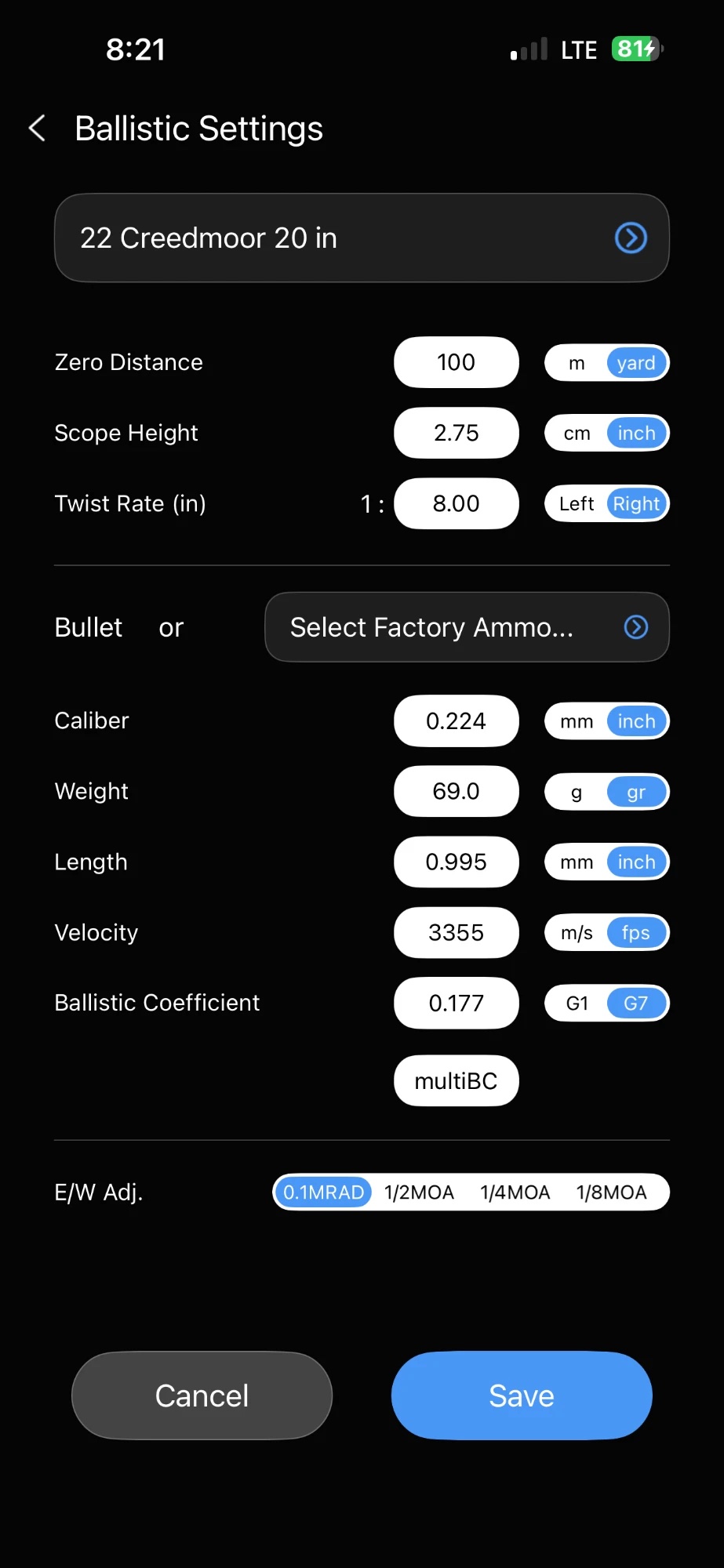
Building a profile in the app is where it is easiest. You enter the zero distance, scope height and barrel twist, then the bullet: caliber, weight, length, muzzle velocity and ballistic coefficient in G1 or G7. You can also pick a factory load from a list and skip the bullet entry. Then you set whether your corrections read in 0.1 MRAD or in 1/2, 1/4 or 1/8 MOA, and sync the profile to the scope.
My profile is the 22 Creedmoor with the 20-inch barrel: a 69-grain bullet at 3,355 fps with a 0.177 G7 ballistic coefficient, a 1:8 twist, a 2.75-inch scope height and a 100-yard zero.
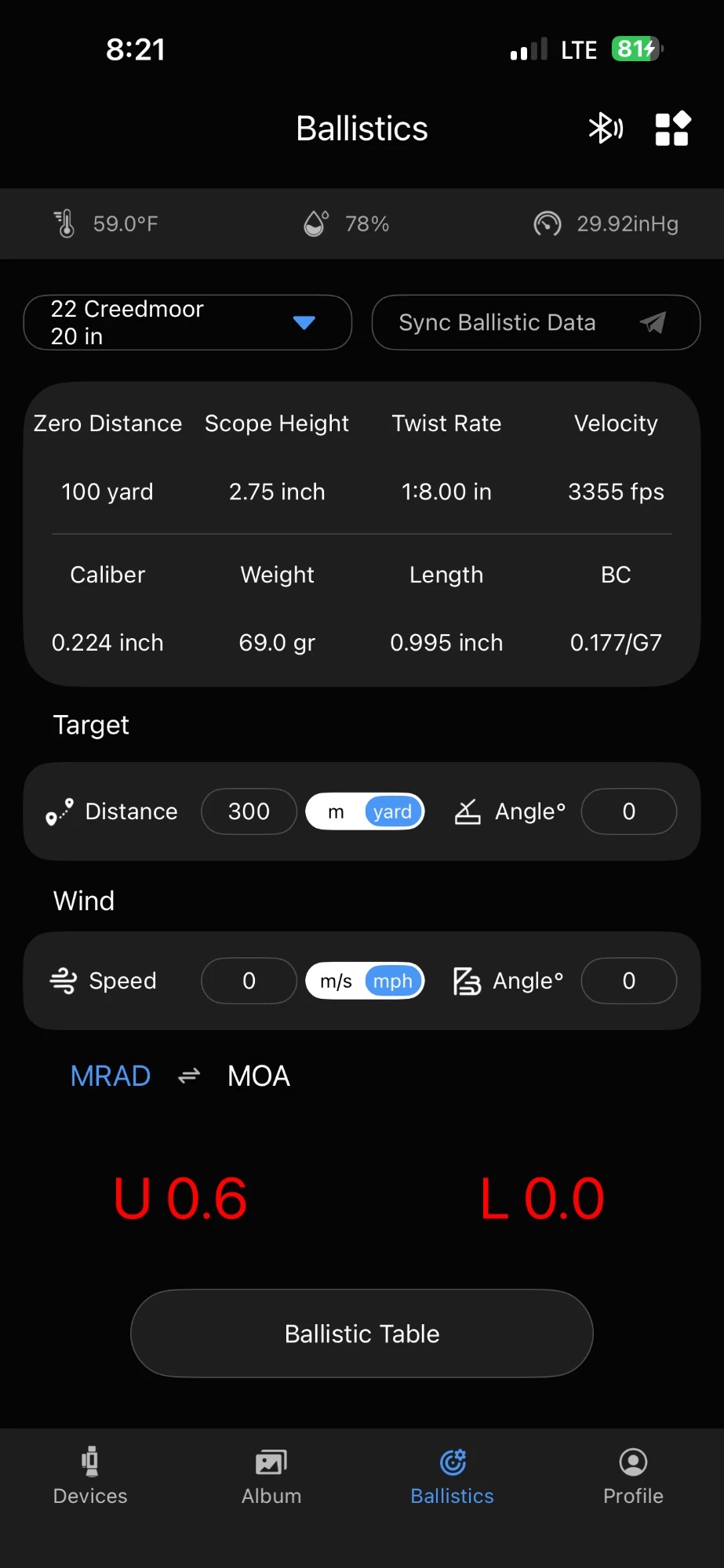
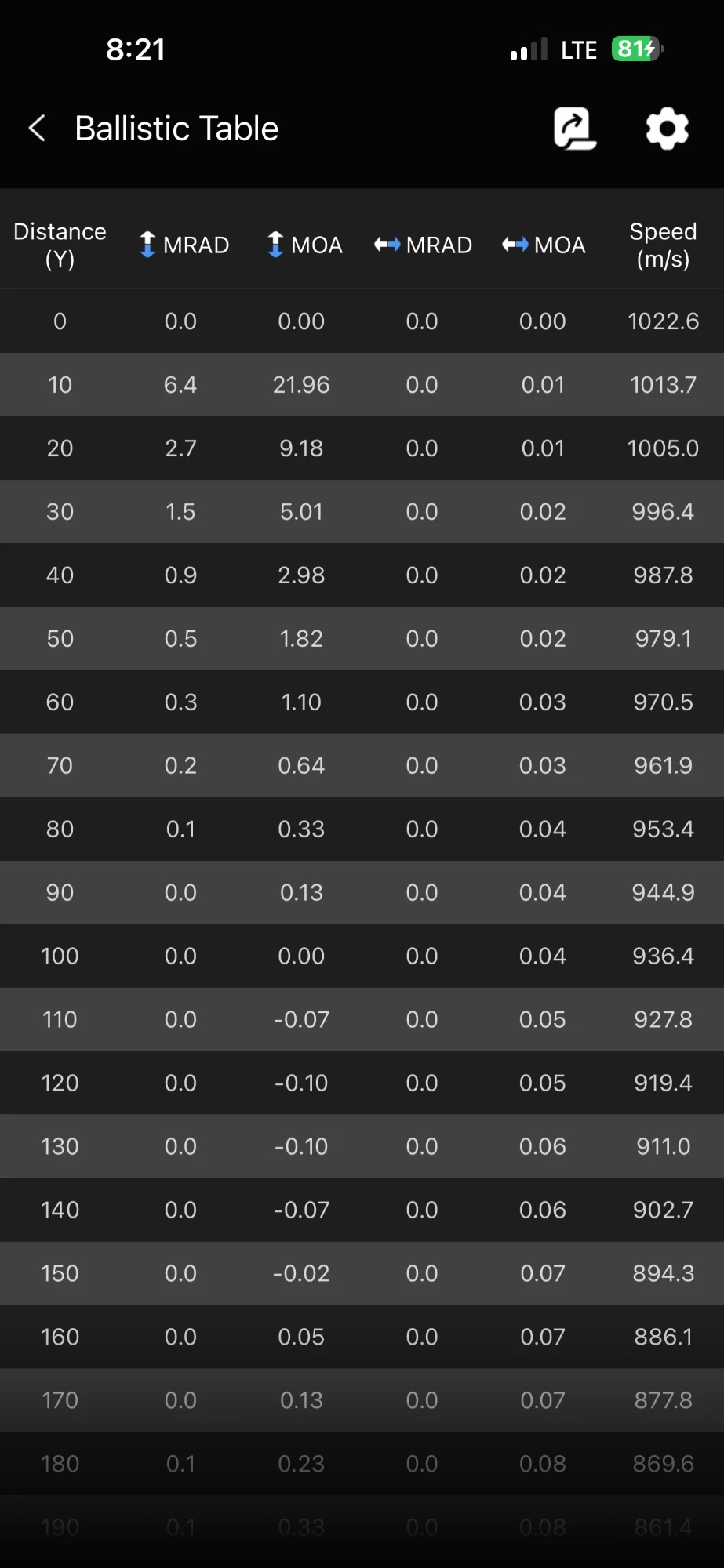
The app also works as a calculator on its own. It takes temperature, humidity and pressure, the target distance and angle, and wind speed and direction, then gives the elevation and wind correction in MRAD or MOA. It will also lay out a full table of corrections and bullet speed by distance.
There are two ways to use the solution. Holdover puts a marker on the screen at the corrected point of aim, so you put that marker on the animal and shoot. Dial In gives you the correction as a number instead. The solution can read in MRAD, MOA, centimeters or inches.
I left the ballistic calculator on and validated it out to 400 yards. Inside that distance, the holds it gave matched where the bullets went.
Mobile app
I think the DNT app is one of the more intuitive mobile applications out there. Ballistic profiles are simple to create and upload to the scope. Downloading both videos and photos is simple too.
The connection is good while in proximity of the thermal. With the scope on the roof of the truck on a magnet mount and a 360-degree remote-controlled pan/tilt, I had an OK connection to my iPad inside the cab and ran a live feed while panning and tilting from my seat. I did have to position my iPad differently to find the sweet spot to connect.
The phone connects over the scope's own Wi-Fi, so it works in the field with no cell service. Once connected, the app shows the scope's live view in real time, which lets someone else watch what you are seeing.
It also handles the scope's five ballistic profiles and its recordings. You can browse the videos stored on the scope, save them to the app, then trim them, merge clips or slow them down, and save the result to your phone or share it. The videos on the scope are only reachable while the phone is connected to it. The app runs on Android 9 and iOS 12 or newer.
The DNT app is available on the Apple App Store and on Google Play.
Recording
The scope records video with audio to 32 GB of built-in storage. Recoil-activated video saves a clip covering the 10 seconds before and after the shot on its own, so you don't have to remember to press record. Clips come off the scope through the app or over USB-C to a computer.
Battery
DNT lists up to 4 hours of battery life per 18650 flat-top rechargeable battery. That matched what I saw: battery life was as advertised.
The flat-top 18650 is one of the most common batteries for thermals, and spares can be found on Amazon at an affordable price. These are the spare batteries I use.
The charger that comes with it works fine, but I prefer this charger because it has a better digital display.
What I like most
The value at it's price point. For what it costs, you get a 640 sensor, a rangefinder, a ballistic calculator, and a scope that works as a dedicated thermal or a clip-on. I think it is the best entry-level 640 thermal on the market that is multi-use.
It is also lightweight and low profile, which makes it a great thermal for both bolt guns and AR-15s. I tested it on a bolt gun, but my preference would be to run it on an AR-15. If you are shopping for a thermal scope with a rangefinder for an AR-15, this one belongs on your list.
I also like the company behind it. DNT is a growing company that has completely changed its go-to-market strategy, and it is focused on getting honest feedback on its products. They didn't pay me, and they asked that I share both the good and the bad. They were awesome to communicate with.
Their community of users has exploded, so there is a ton of feedback out there about other people's experiences with these scopes.
What I'd change
I'd like more base magnification. Where I hunt in Wisconsin it is wide open agricultural fields, and the average coyote kill is 200 yards. A higher base magnification would make this scope great for longer shots.
My recommendation for the rangefinder is to mount it further forward, or build it into the objective lens itself. Either would keep a hand from covering it.
I'd also like more customization of the display. For example, the tilt and cant indicator: I'd want the option to remove it completely, or to show cant only with a simpler bubble-level style indicator.
And I'd like more control from the mobile app, such as being able to zoom in from the phone.
I'd also like to be able to name the gun profile from the app, for example "22 Creedmoor Bolt Action", so that it matches the name of the ballistic profile.
Bottom line
I would buy this scope with my own money. DNT sent it to me for review, and I am considering buying the demo unit from them rather than sending it back.
At $2,199.99 on sale, you get a sensor that finds coyotes at 400 yards and holds up in fog and humidity, a zero that is easy to set and comes back after the scope has been off the rifle, a ballistic calculator I validated to 400 yards, and one of the more intuitive apps around. It suits a hunter who wants one thermal to move between a bolt gun and an AR-15, or between a rifle and a truck mount.
If you want the best thermal on the market, regardless of price, I would look at other units. If you want the best thermal for the money, this is the best one offered right now. It does not come in under $2,000, but at the sale price I think it is the best thermal scope for coyote hunting under $2,500 in 2026.
Give yourself time to learn it. The rangefinder took me some getting used to, its button sits where a hand can cover it, and in open country you may want more than 2.5x of base magnification.
Comments
No comments yet. Be the first to leave one.
Log in Create account